

How to read the table
- Cloud voices: how many neural voices you can pick. 60 of the 75 languages have exactly two, one female and one male.
- Regions and accents: regional variants (locales), written as a language code and a country code: es-MX is Spanish as spoken in Mexico, fr-CA is Canadian French. Choose the accent your listeners expect.
- Browser: whether the language also works with the voices that run on your device.
- Pages: our own pages for that language, for text to speech or speech to text, where they exist. Transcription itself covers about 99 languages.
The data is the voice list of our cloud speech service on 16 November 2026; the provider can add or remove voices. To compare voices, open the voice catalog.
Cloud voices or browser voices?
Cloud voices are synthesized through our server, cover all 75 languages, highlight each word as it is read, and need a connection.
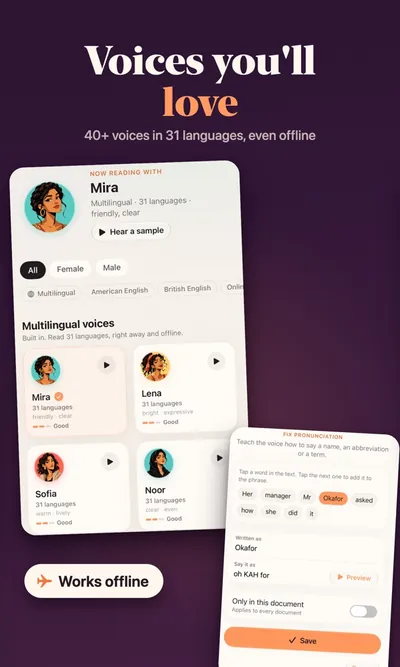
Browser voices use the Supertonic 3 model, which downloads once and then runs on your device, so your text is not sent anywhere. The same 10 voices cover 31 languages, from Arabic to Vietnamese, and in those languages the text to speech tool keeps working when the cloud is down. Chinese, Hebrew, Persian, Thai and the other 40 languages need the cloud voices.
Language pages
Some languages have their own page with the voices, a sample text and reading notes, such as Spanish text to speech and Japanese text to speech, or, for recordings, Spanish speech to text. To transcribe a file in any language, use speech to text.