

Spanish voices by region
Spanish has more accents here than any other language: 22 locales, each with a female and a male voice. Spain has a third.
| Region | Locale: voices (female first) |
|---|---|
| Spain | es-ES: Elvira, Ximena, Alvaro |
| Mexico | es-MX: Dalia, Jorge |
| United States | es-US: Paloma, Alonso |
| Central America | es-GT: Marta, Andres; es-HN: Karla, Carlos; es-SV: Lorena, Rodrigo; es-NI: Yolanda, Federico; es-CR: Maria, Juan; es-PA: Margarita, Roberto |
| Caribbean | es-CU: Belkys, Manuel; es-DO: Ramona, Emilio; es-PR: Karina, Victor |
| Andes | es-CO: Salome, Gonzalo; es-VE: Paola, Sebastian; es-EC: Andrea, Luis; es-PE: Camila, Alex; es-BO: Sofia, Marcelo |
| Southern Cone | es-AR: Elena, Tomas; es-UY: Valentina, Mateo; es-PY: Tania, Mario; es-CL: Catalina, Lorenzo |
| Africa | es-GQ: Teresa, Javier |
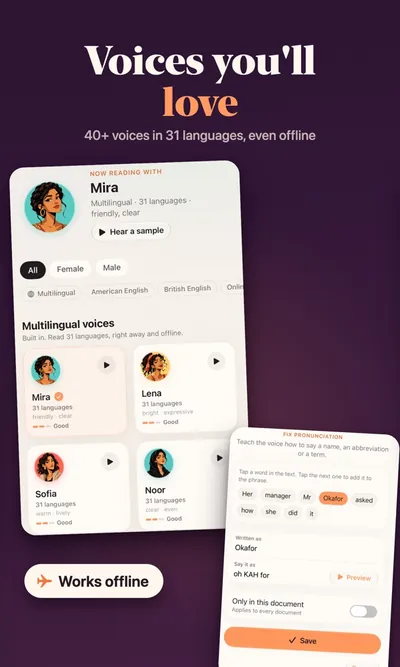
The voice list filters them by locale and gender.
Castilian or Latin American: what changes
The first difference people notice is one sound. In most of Spain, z and c before e or i are said like English “th” (distinción), while Latin America says them with an s (seseo). Play cerveza or cielo with an es-ES voice and with Dalia to hear which one you want. Rioplatense Spanish is known for a “sh”-like ll and y in calle and yo; play a sentence with those letters in Elena or Valentina before you pick them for a wider audience.
Vocabulary and grammar come from your text, not the voice. Match the two: a script from Spain with an es-ES voice, a Mexican one with Dalia or Jorge.
Tildes, ¿ ¡ and numbers
- Written accents. Stress follows the tilde, so text typed without accents can turn into other words: papá (dad) becomes papa (potato), está becomes esta.
- Opening marks. Keep ¿ and ¡. There is no SSML, so the voice takes pauses and intonation from punctuation alone.
- Number formats. Spain writes 1.250 € and 7,5; Mexico and the US usually write 1,250 and 7.5. In our test on 16 November 2026, Dalia’s word timings treated 15/03/2027, las 18:30 and 1.250 € each as one unit, not as separate digits; we did not check by ear how each was phrased. A short date like 03/04 is ambiguous for a mixed audience: write “3 de abril”.
Pace and gaps
At 1×, Elvira read our 93-word test passage at 170 words per minute and Dalia at 167; the speech time calculator turns a word count into minutes. Spanish also works with the on-device browser voices. There is no Basque voice and no voice cloning.
To go the other way, Spanish speech to text turns recordings into text and subtitles.