

French voices by country
| Country | Locale | Female | Male |
|---|---|---|---|
| France | fr-FR | Denise, Eloise, Vivienne Multilingual | Henri, Remy Multilingual |
| Canada | fr-CA | Sylvie | Antoine, Jean, Thierry |
| Belgium | fr-BE | Charline | Gerard |
| Switzerland | fr-CH | Ariane | Fabrice |
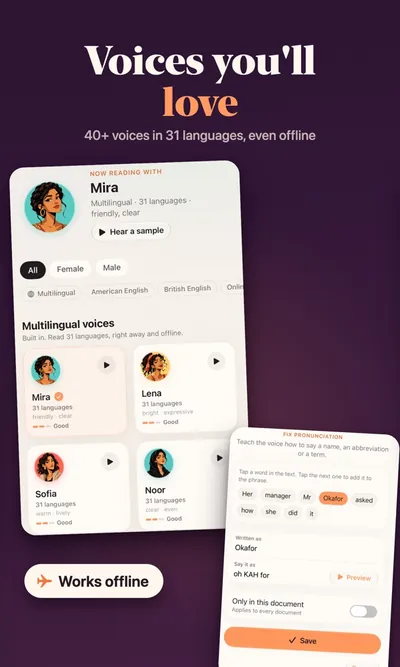
France has the widest choice, and Canada is the only locale with more male voices than female ones. All 13 are in the voice list with filters.
Paris or Montreal
A Canadian listener spots a Paris accent in one sentence, and the other way round, so pick the voice by audience first. Quebec French has its own vowels and rhythm, and its own words: courriel, magasiner, fin de semaine. The voice reads the vocabulary you give it, so a Quebec script belongs with Sylvie or Antoine, and a text full of “week-end” and “faire du shopping” sounds more natural with Denise or Henri.
Liaison, silent letters and big numbers
French spelling hides a lot of its sound. Final consonants are often silent, and liaison links words (les‿enfants, un petit‿ami). You write normal French and the voice decides where the links go. Rare words, brand names and acronyms are where it is most likely to slip, so listen to them before you export; how to fix pronunciation has workarounds.
Numbers have two systems. France says soixante-dix (70) and quatre-vingt-dix (90); Belgium and Switzerland say septante and nonante. If one form must be heard for sure, write the number out in letters.
In our test on 16 November 2026, the word timings of both Denise and the Belgian voice Charline treated 16/11/2026, 18h30 and 1 250 € (with a space as the thousands separator) each as one unit, not as separate digits; we did not check by ear how each was phrased. For anything unusual, such as a range like 14-18 or a Roman numeral, writing the words is the safe choice.
Pace and offline use
On our 95-word French passage at 1×, Denise read 186 words per minute and Henri 197. Both are faster than the German voices we measured. French is also available as a browser voice that runs on your device (browser mode).
For the reverse task, French speech to text transcribes French recordings into text and subtitles.